
Written by Matthew Travers, Co-Founder and President, Lead to Recovery. Updated October 18, 2026. This page replaces our 2025 trends forecast and grades it below.
Drug rehab marketing in 2026 is decided in three places: the Google Maps pack, which appeared on 34 of 40 high-volume rehab searches we checked; AI answers, which now sit on top of the “what is IOP” and “how much does rehab cost” questions; and the admissions line, where more calls no longer mean more patients. The centers gaining ground measure cost per admission, publish what families ask about, and build within the 2025 and 2026 rule changes on ads, privacy and consent.
Key takeaways
The 2026 Market in Numbers
In short: Demand far exceeds treatment, and supply is crowded at the outpatient level, so local visibility and payer clarity decide who gets the call.
SAMHSA’s 2025 National Survey on Drug Use and Health counted 44.6 million Americans aged 12 and older with a substance use disorder. Of the 47.2 million who needed substance use treatment, 16% received it. On the supply side, SAMHSA’s 2024 N-SUMHSS counted 15,953 substance use treatment facilities, and 8.4 of every 10 offer outpatient care.
The gap is not a shortage of searches. Families search, call and compare. The trends below are about who they find and what happens after they call.
Our 2025 Forecast, Graded
In short: We published eight trends for 2025 on this page. Two held, three changed shape under new rules, two remain unproven as admission drivers, and one became the most important trend of 2026.
| 2025 trend we predicted | What happened by 2026 | Grade |
|---|---|---|
| Data-driven marketing | Held, but the metric changed: cost per admission replaced lead counts after call volume and admissions stopped moving together (Trend 4). | Held |
| AI and automation, including chatbots | Changed: AI moved to the search results page (Trend 2). Chat and automation now sit inside HIPAA and Part 2 obligations (Trend 7). | Changed |
| Video and interactive content | Useful for trust on program pages. None of our clients tracks it as an admission source, so we cannot show it moved cost per admission. | Unproven |
| Local SEO | The strongest trend of 2026: the Maps pack sits on 34 of 40 high-volume rehab searches (Trend 1). | Grew |
| Social media on Instagram and TikTok | Changed: Meta requires LegitScript and written permission for addiction treatment ads, and health targeting is restricted (Trend 6). | Changed |
| Ethical and compliant marketing | Held and hardened: Part 2 enforcement, the FTC review rule, a federal court ruling on marketer pay (Trends 6 to 9). | Held |
| Personalization | Changed: Google treats health as a sensitive category, so remarketing lists and Customer Match are off the table for these ads (Trend 6). | Changed |
| Sustainability and community engagement | Not measured as an admission source in any campaign we track. Community work still matters for referral relationships. | Unproven |
1. Google Maps Decides the First Call
In short: The local pack appears on 34 of 40 high-volume rehab searches, covering 91% of their search volume, so the Business Profile is the front door.
We pulled Google results data from Ahrefs for 40 searches families make when they look for care, from “rehab near me” (11,000 a month) to “detox centers near me” (8,900) and “methadone clinic near me” (7,700). Together they total 169,300 searches a month in the US.
Three findings shape the year:
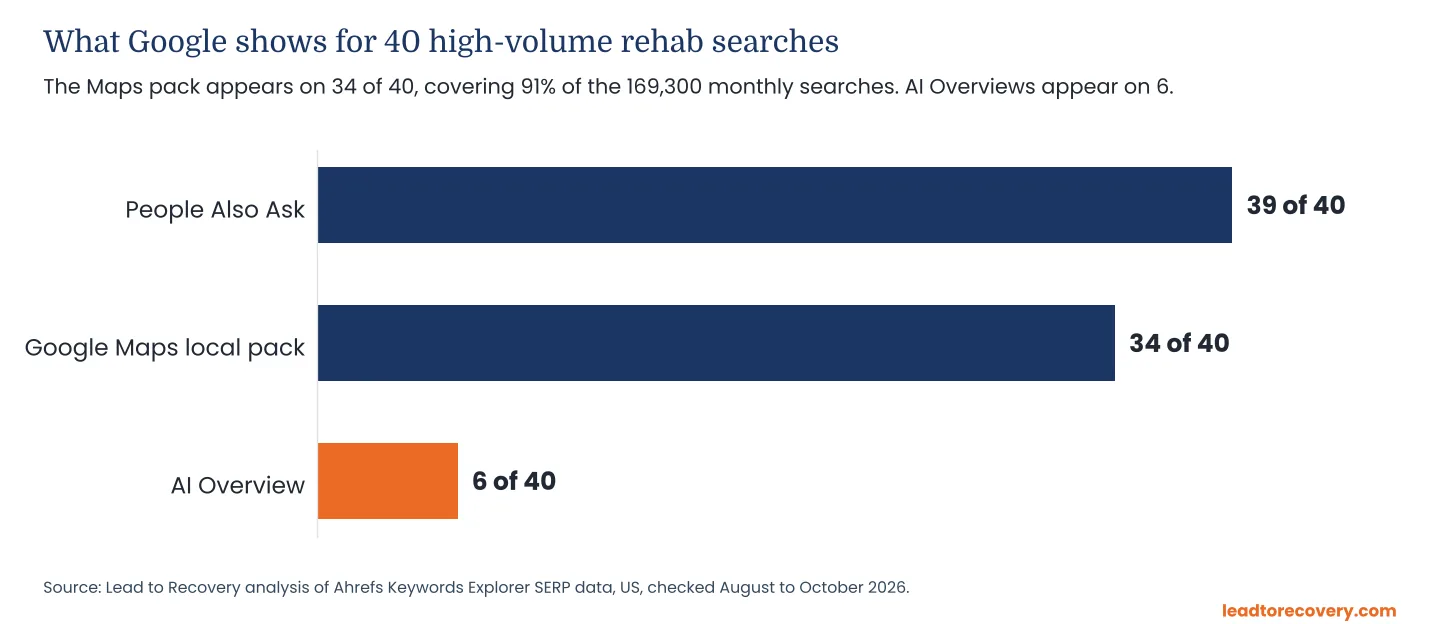
Figure 1. SERP features on 40 high-volume US rehab searches. Lead to Recovery analysis of Ahrefs data, checked August to October 2026.
Google ranks local results on relevance, distance and prominence. A center cannot move its address, so relevance and prominence are the levers: categories and services that match each level of care, reviews, and a website that confirms what the profile claims. Google lists lead generation companies as ineligible for a Business Profile, which leaves the Maps pack to treatment providers. Our Business Profile guide for treatment centers covers the rules.
2. AI Overviews Took the Educational Questions
In short: AI Overviews appeared on 6 of the 40 searches, and every one was a question about what a program is or what it costs.
The six: “intensive outpatient program” (9,500 searches a month), “partial hospitalization program” (5,200), “dual diagnosis treatment” (2,600), “how much does rehab cost” (1,300), “inpatient mental health facility” (900) and “fentanyl detox” (800). That is 20,300 searches a month, 12% of the set, where an AI summary sits above the first organic result.
Commercial “near me” searches still go to the Maps pack. Educational searches go to the AI answer, and the AI answer cites pages. To be the page an AI answer cites, define the level of care in the first two sentences of its page, describe what a day looks like, and state cost and payers plainly. Our answer engine optimization work starts there, and the free AI visibility tool shows where a center stands today.
3. Price Is the Open Lane
In short: One of 100 top-ranking treatment center websites publishes a price, so the first center in a market to answer the cost question has no competition for it.
Our October 2026 audit of the two highest-ranking treatment center sites in every state found 1 of 100 publishing a price for its own treatment and 0 publishing prices by level of care. 76 named insurance carriers, 54 offered an insurance verification form, 97 put a phone number on the homepage, and 48 said nothing about Medicaid.
Sites are built to start a conversation, not to answer the first question a family asks. A page that states a starting rate, a per-day Medicaid rate or a sample bill for a 30-day stay answers a question the top-ranking sites in its state leave open.
4. More Calls Stopped Meaning More Admissions
In short: At one Arizona center, qualified paid calls rose 182% while paid admissions rose 39%, so each admission took twice as many calls.
From January to August 2025, the center’s paid search produced 287 qualified calls (two minutes or longer) and 23 admissions. In the same months of 2026: 808 calls and 32 admissions. That is 12.5 calls per admission, then 25.3. A report built on lead counts would call 2026 a breakout year. The Arizona case study shows why the center measures cost per admission instead.
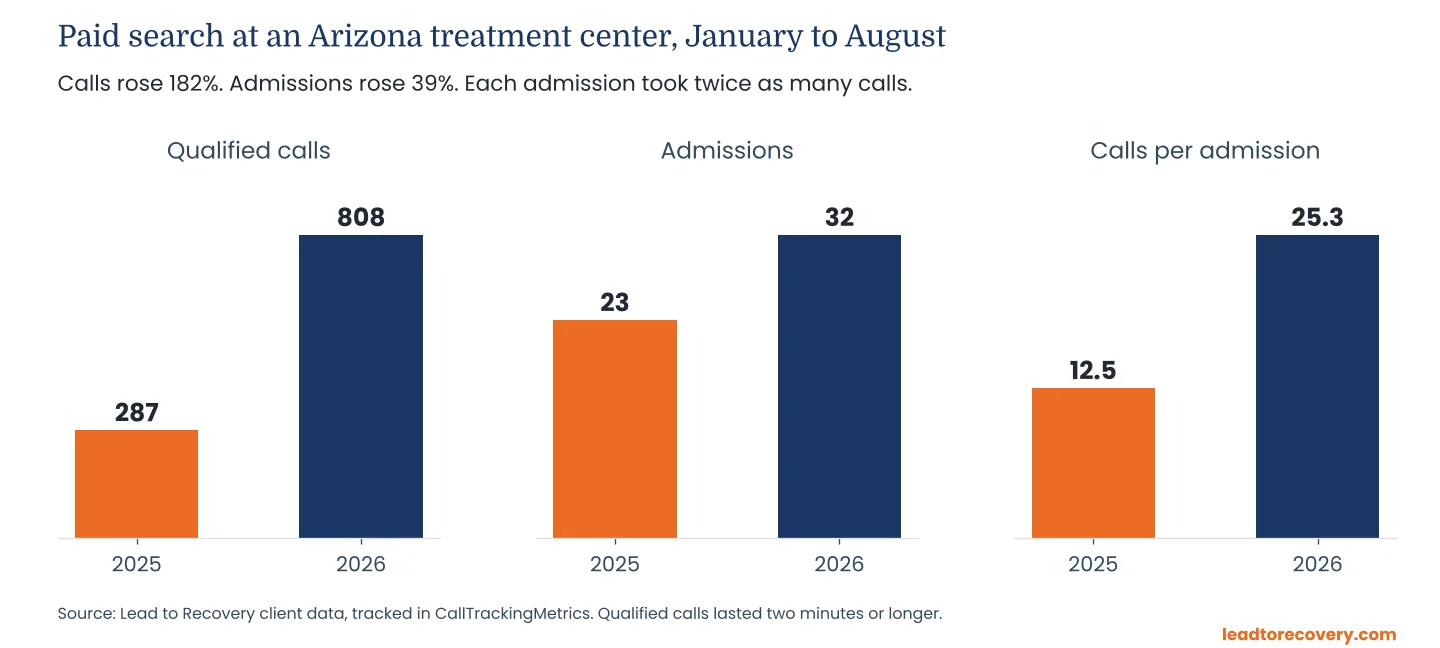
Figure 2. Paid search at an Arizona treatment center, January to August. Lead to Recovery client data, tracked in CallTrackingMetrics.
Catching this takes two habits: tracking that ties every admission to the call that produced it, and a monthly review that moves budget toward the lowest cost per admission. Our KPI tracking is built for that review, and our lead generation analysis shows how to price a purchased call against the admission.
5. Organic Search Carried the Admissions
In short: At the same Arizona center, organic search produced three of every four digital admissions in 2026, and its cost per admission fell 41%.
Organic admissions rose from 62 to 105 on the same SEO spend, so organic cost per admission fell from $1,548 to $914. Blended cost per admission across every channel held nearly flat, from $2,564 to $2,578, while total admissions grew 61%.
The pattern repeats elsewhere. A New Jersey center reached 6 to 8 organic admissions a month inside 180 days at a $600 average cost per admission, and a Pennsylvania center logged 108 first-time organic calls and 4 admissions in its first three months. Paid search fills the gap while SEO matures; it does not replace it.
6. Paid Ads Work Inside Tighter Rules
In short: Certification still gates every major ad platform, Google opened Canada in 2025, and health targeting rules removed remarketing from the playbook.
Google, Meta, Microsoft and Nextdoor require LegitScript Addiction Treatment Certification for drug and alcohol treatment ads, and Google and Meta each run a second approval afterward (Google policy, Meta standard). Lead generators and sober living homes without licensed clinical services are not eligible. Three changes matter in 2026:
Our LegitScript guide, Google Ads policy guide and social media ad rules guide cover each platform. Rehab PPC management starts after both approvals clear.
7. Part 2 Penalties Arrived
In short: Since February 16, 2026, HHS enforces the confidentiality rules for substance use disorder records with HIPAA-level penalties, which reaches tracking, chat and testimonials.
HHS announced on February 13, 2026 that its Office for Civil Rights would accept complaints and breach notifications under 42 CFR Part 2 from February 16, with penalties that align with HIPAA’s. For marketing teams, three surfaces carry patient data: pixels and analytics tags on pages a patient uses, chat and form tools, and testimonials.
Testimonials already have a price tag. In September 2025, HHS settled with Cadia Healthcare Facilities for $182,000 after it posted a patient’s name, photo and recovery details as a website success story without written HIPAA authorization. Any vendor that touches patient information needs a signed Business Associate Agreement. Our HIPAA-compliant marketing guide walks through the stack.
8. Speed and Consent Decide the Admission
In short: The answered call is the one that can become an admission, and since April 11, 2025 any reasonable request to stop calls or texts has to be honored within 10 business days.
The FCC’s revocation of consent rule took effect April 11, 2025: a consumer can revoke consent in any reasonable way, words like “stop” and “unsubscribe” count, and the request has to be honored within 10 business days. A broader “revoke all” provision was pushed to January 31, 2027 by FCC order DA 26-12.
The operational trend is simpler: answer every call. In the Arizona data, qualified calls nearly tripled while admissions grew 39%. Missed calls, slow callbacks and after-hours voicemail are the part of that gap a center controls. Our speed to lead guide covers response time and call handling.
9. Trust Signals Face Rules of Their Own
In short: Reviews, accreditation badges and photos now carry legal weight, so trust signals have to be real to work.
The FTC’s rule on fake reviews and testimonials, effective October 21, 2024, bans fake reviews, bought reviews and undisclosed insider reviews, with civil penalties per violation. LegitScript requires facility photos that truthfully depict the actual facilities. Accreditation is the norm among visible centers: 71 of the 100 top-ranking sites in our audit display Joint Commission or CARF accreditation.
Trust signals that hold up in 2026: real staff with credentials, real facility photos, accreditation the center holds, and reviews earned and answered without disclosing patient information.
Your 2026 plan
Six Moves for 2026, in Order
Questions operators ask
Drug Rehab Marketing Trends: FAQs
Method and Sources
How we checked the search results: 40 US searches that families use to find care, chosen across levels of care, substances and “near me” phrasing, with 169,300 combined monthly searches. SERP features, search volume and device split come from Ahrefs Keywords Explorer, with results last checked between August 27 and October 17, 2026. Results vary by location and change over time; the counts describe the results Ahrefs recorded.
- SAMHSA. “SAMHSA Releases Annual National Survey on Drug Use and Health (2025 NSDUH),” July 27, 2026.
- SAMHSA. “Companion Infographic Report: Findings from the 2024 N-SUMHSS,” 2025.
- Google Ads Help. “Healthcare and medicines: addiction services,” accessed October 2026.
- Google Ads Help. “Update to Healthcare and Medicines policy (March 2025),” posted February 3, 2025.
- Google Ads Help. “Restricted targeting in personalized advertising,” accessed October 2026.
- LegitScript. “Addiction Treatment Certification,” accessed October 2026.
- Meta Transparency Center. “Drug and Alcohol Addiction Treatment,” accessed October 2026.
- Google Business Profile Help. “Tips to improve your local ranking on Google,” accessed October 2026.
- Google Business Profile Help. “Business eligibility and ownership guidelines,” accessed October 2026.
- U.S. Department of Health and Human Services. “HHS announces civil enforcement program for SUD patient records,” February 13, 2026.
- U.S. Department of Health and Human Services. “OCR settles HIPAA case with Cadia Healthcare Facilities,” September 30, 2025.
- Federal Trade Commission. “Final rule banning fake reviews and testimonials,” August 14, 2024.
- Federal Register. “Strengthening the Ability of Consumers To Stop Robocalls,” March 5, 2024.
- Federal Communications Commission. “Order DA 26-12,” January 6, 2026.
- Legal Information Institute. “18 U.S.C. 220,” accessed October 2026.
- U.S. Court of Appeals for the Ninth Circuit. “United States v. Schena, No. 23-2989,” July 11, 2025.
- Lead to Recovery. “How Much Does Rehab Cost in 2026? What 100 Treatment Center Websites Disclose,” October 17, 2026.
- Lead to Recovery client data: Arizona SEO and PPC, New Jersey regional SEO, Pennsylvania local SEO.
This article describes rules and what they say. It is not legal advice; confirm how they apply to your center with healthcare counsel.

