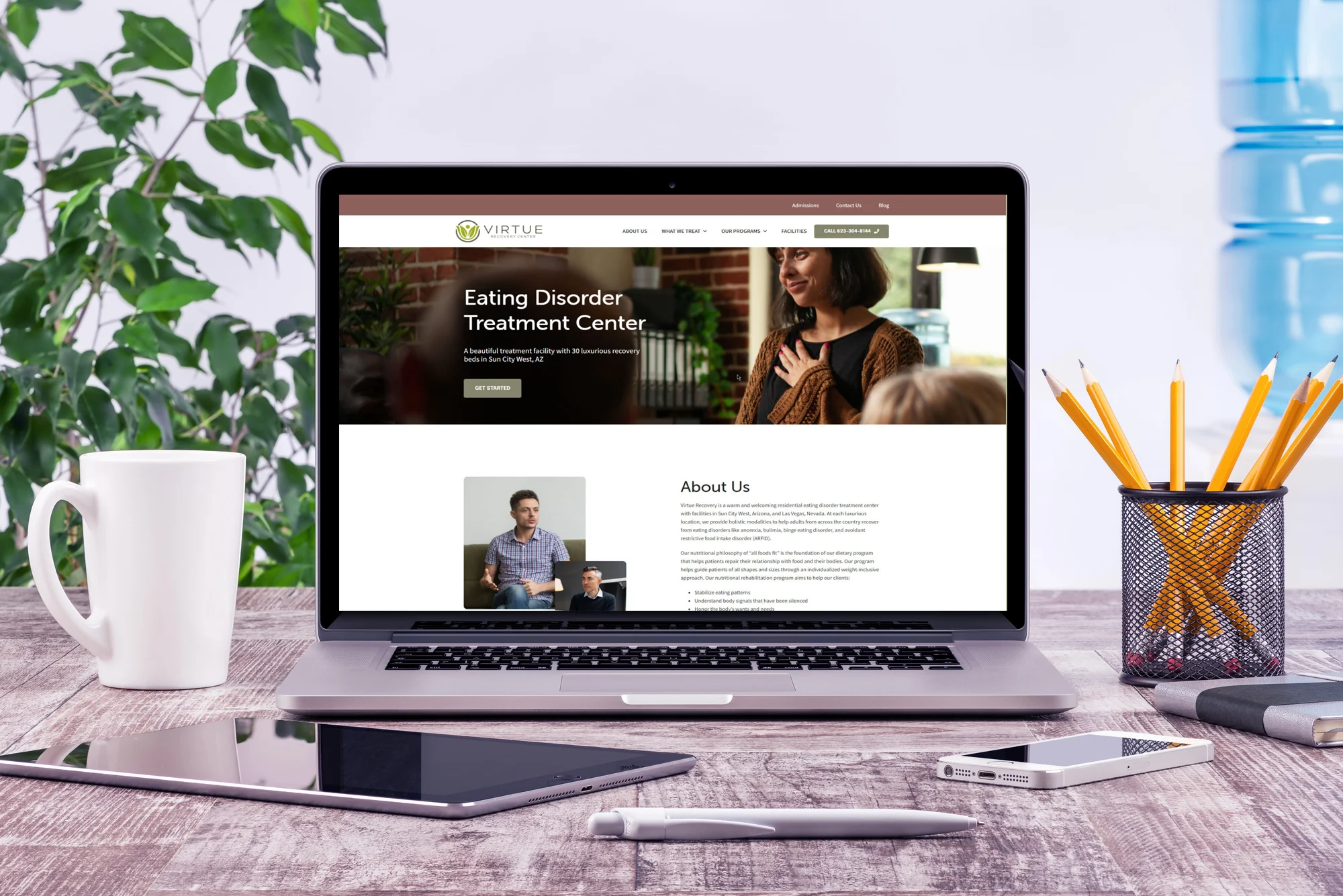
a concept image for creating a rehab center website design that engages users

Conversion-Focused Website Design For Eating Disorder Treatment Centers

Conversion-Focused Website Design For Eating Disorder Treatment Centers

Transform your website from a digital brochure into a patient acquisition platform designed specifically for the emotional complexity of eating disorder treatment, one that turns first-time visitors into clinical intakes.

Last Updated: April 17, 2026

a concept image for creating a rehab center website design that engages users

Book a Discovery Call

If you prefer to speak with someone
now please call 855-876-7238.

Key Takeaways

  • Acquisition-Focused Design: Websites built to turn visits into clinical intakes, not just inform.
  • Sensitive Audience Architecture: Pages structured for the unique decision-making journey of individuals and families navigating eating disorder treatment.
  • WordPress and Avada Power: Professional-grade flexibility without platform lock-in.
  • Zero-Friction Forms: Streamlined intake flows that remove barriers to contact at the most critical moment.
  • Mobile-Dominant Performance: Optimized for the late-night, high-stress search that defines this audience.
  • Speed and Technical Health: Specialized optimization for Google’s Core Web Vitals.
  • The Marketing Catalyst: A technical foundation that lowers cost-per-lead and strengthens SEO rankings.
test

Eating Disorder Treatment Website Design Requires A Different Approach

Most web agencies measure success by how a site looks at launch. In eating disorder treatment, that is the wrong metric. A site can be visually polished and still fail the person who lands on it at their most vulnerable moment because the copy reads like a brochure or the contact form asks for too much too soon. Knowing how to structure that experience without being overwhelming or triggering is a unique skill set, and one that Lead To Recovery is proud to possess.

The person arriving on your site may be in a fragile state.

Someone searching for eating disorder treatment is not browsing casually. They may be in the middle of a crisis, or they may have finally worked up the courage to look for help after months of avoidance. Your website has a very short window to signal that you understand what they are going through, not through clinical language or credential lists, but through warmth, clarity, and the sense that real people who know this space built this site. Generic healthcare templates do not accomplish this.

The decision to seek treatment is rarely made in a single session.

An individual or family member considering eating disorder treatment is not going to fill out a contact form after reading one page. They are going to read about your clinical approach, look at your staff, try to understand what daily life looks like in your program, check insurance coverage, and likely return multiple times before reaching out. Your site needs to be architected for that journey, not optimized for a visitor who converts immediately.

Local search performance has to be built in from the start.

If your website isn’t structured with local SEO in mind from the beginning, proper URL architecture, location page structure, schema markup, page speed, and mobile responsiveness, you will spend money later trying to fix foundation problems that should never have existed. We treat organic performance as a design requirement, not something to layer on afterward.

Intake forms and contact mechanisms carry real compliance weight.

Depending on what information you collect and how you store it, your contact and intake forms may touch HIPAA-sensitive territory. We build contact flows that are conversion-optimized and structured with those considerations in mind from the first line of code.

What Lead to Recovery Builds for Eating Disorder Treatment Centers

Our builds run on WordPress with premium frameworks like Avada because that combination gives eating disorder treatment centers something most platforms cannot: full design control, clinical-grade performance, and a backend your team can actually manage without support (though we do offer support). No proprietary lock-in, no fragile custom code that falls apart at the next update.

A homepage built around the first-time visitor.

Your homepage has one job: give someone who doesn’t know you yet a reason to stay. That means communicating clearly what you treat and who you serve, establishing clinical credibility without overwhelming, using real imagery that reflects the warmth and humanity of your program, and making the path to contact obvious at every point on the page. We develop copy and design together, because the two built separately rarely convert.

Service pages that answer the questions people are actually asking.

Someone researching eating disorder treatment wants to understand what a typical day looks like in your program. They want to know how levels of care work, what the difference is between residential and outpatient treatment, how insurance verification works, and whether your clinical philosophy aligns with what they have read or been told. We structure service pages around those questions, not around internal terminology or accreditation language.

Location pages that support local search.

 If you serve multiple cities, each one gets a dedicated page built with genuine local relevance, not a copied template with the city name swapped in. These pages serve your SEO, but they also serve the person reading them, who wants to know that your program understands and operates within their community.

Staff pages that build the human connection.

In eating disorder treatment, trust in the people providing care is often the deciding factor. A staff page with real photos, real credentials, and real language about each clinician’s approach and background does more conversion work than almost any other page on the site. We help you tell those stories in a way that is genuine and compliance-aware.

A contact and intake flow that does not lose people at the last moment.

The moment someone decides to reach out is fragile. A form with too many required fields, no visible phone number, and no indication of what happens next will lose them. We design contact flows that are short, clear, and followed by an immediate confirmation that sets expectations: what happens next, how quickly you will respond, and what the first conversation will look like.

Mobile-first at every stage.

Individuals and families searching for eating disorder treatment are predominantly on mobile devices, often late at night and under significant emotional pressure. We design for mobile first and desktop second, not the reverse, which is how most agency templates still operate.

Page speed as a non-negotiable.

Slow sites lose visitors before they read a single word of your content, and page speed is a direct Google ranking factor. Every site we build is optimized for Core Web Vitals from the start, image compression, caching, clean code, and hosting that supports the performance targets we are building toward.

rehab marketing ideas from a lead magnet agency 1

A Website Is the Foundation, Not the Finish Line

A well-built website is the most important marketing asset your eating disorder treatment center has, but it is only as valuable as the traffic and strategy behind it. A site that converts at 4% is dramatically more effective than one that converts at 1%, but only if people are actually landing on it.

That is where the natural next conversation becomes SEO and paid search. Once your ED clinic website is built correctly, with proper technical foundations, local page structure, and conversion-optimized copy, it becomes a platform that organic and paid strategies can actually leverage. Running search ads to a slow, poorly structured site is expensive and inefficient. Running them to a site built for conversion is a different proposition entirely.

We work with eating disorder treatment centers on all three: design, SEO, and PPC. The results are meaningfully better when the foundation is right. If you are already working with another agency on traffic, a new site will make their work more effective too. We will be straightforward with you about where the opportunities are.

See What a Conversion-Focused Redesign Could Look Like for Your Eating Disorder Clinic

Our free website review covers your current site’s conversion structure, mobile performance, page speed scores, local SEO readiness, and the specific friction points that are likely costing you inquiries. We’ll show you what we find and what we’d do differently, before any engagement begins.

What Results Look Like


The performance of eating disorder treatment websites is not measured at launch. It is measured three months later when you can see whether the people landing on your site are actually reaching out, and whether the ones who reach out are the right fit for your program.

We track the numbers that connect to your intake pipeline: form submissions, phone call conversions, bounce rate by landing page, page speed, and organic ranking movement. When a new site is built alongside an SEO or PPC engagement, each element makes the others more effective. Stronger technical foundations lift organic rankings. Better landing pages bring down paid cost-per-lead. Better conversion structure means more of your existing traffic turns into inquiries without spending more to acquire it.

digital marketing services for private practice therapists 1

How an Eating Disorder Treatment Website Design Engagement Works

Frequently Asked Questions

For most engagements, the full process from discovery through launch runs eight weeks. That timeline assumes reasonable responsiveness on content approvals and feedback cycles. Larger, multi-location eating disorder clinic sites or those requiring significant custom development may run longer. We will give you a realistic timeline before the engagement begins, not an optimistic one designed to win the project.

Pricing depends on the scope of the build, number of pages, whether we are writing copy, the complexity of the intake flow, and whether location pages are part of the initial build or a subsequent phase. We don’t publish flat rates because a number without context isn’t useful to you. What we do offer is a free site review that gives us both a clear picture of what a realistic engagement would require.

WordPress powers a significant portion of the web for good reason. It gives us full design and performance control, integrates with the tools eating disorder treatment centers actually use, and doesn’t lock you into a proprietary ecosystem that limits what you can do as your needs evolve. Platforms like Wix or Squarespace are easier to use but create real constraints on performance, SEO, and customization that matter at the level of marketing we are building toward.

Yes, and in some cases that is the right approach. Whether we rebuild or redesign depends on what the audit reveals. If your current site has strong technical bones and established SEO equity, a redesign that preserves that foundation often makes more sense than starting over. If the structure is working against you, a rebuild is the faster path to results. We will tell you honestly which situation you are in.

A properly built site will remove the technical barriers that are likely limiting your current rankings and give your SEO strategy a foundation it can actually build on. Site speed, mobile responsiveness, URL structure, schema markup, and local page architecture all directly affect organic performance. A new site doesn’t guarantee rankings, but a poorly built one actively limits them.

Ready to Start Building A Website Designed to Convert?

The free website review takes a close look at what your current site is actually doing, where visitors are leaving, what’s slowing it down, what’s missing from the conversion path, and what a rebuilt version could realistically accomplish for your center.

No obligation. No templated recommendations. Just an honest assessment from a team that has spent years building websites for behavioral health providers who can’t afford to have their most important marketing asset working against them.

Content written by marketing expert Olivia Mungal

Content written by marketing expert Olivia Mungal

Olivia Mungal is the Operations Manager at Lead To Recovery and brings 18+ years of experience in digital marketing, SEO, content strategy, and brand lifecycle management. Her background also includes experience in web design, UX/CX, product management, brand management, and email marketing.

oliviaauthorfinal

Olivia Mungal

Operations Manager

Olivia Mungal

Operations Manager