Problem:
When this addiction treatment and mental health center came to Lead to Recovery, they were facing a challenge that’s all too familiar in behavioral health: a quality facility with real clinical expertise, but almost no visibility online.
Located in PA, the center provides a broad range of services for both adults and adolescents, including Intensive Outpatient Programs (IOP), Partial Hospitalization Programs (PHP), outpatient care, adult day treatment, and specialized teen treatment services. The clinical offerings were strong. The digital presence was not.
Their Google Business Profile was underperforming, generating minimal website clicks and almost no phone call engagement through the listing. Organic search visibility was effectively nonexistent, impressions and clicks from Google were near zero. In a competitive market where established treatment centers have been building their online authority for years, this meant the facility was invisible to the families and individuals actively searching for the exact services they provide.
The urgency was real. Empty beds cost treatment centers thousands of dollars a day in unrealized revenue, and the clinical team was ready to help people, they just needed the phone to ring. The center needed a strategy that could build local search visibility quickly, drive qualified leads, and lay the foundation for sustained organic growth over time.
Solution:
Lead to Recovery developed a focused local SEO and Google Business Profile optimization strategy designed to move the needle fast while building long-term search authority. Because we specialize exclusively in behavioral health marketing, we were able to skip the learning curve that generalist agencies face when entering this space and immediately apply tactics informed by years of experience in addiction treatment and mental health SEO.
Here’s how we approached it:
Outcome
From November 12, 2025 through February 21, 2026, a span of roughly three months, the campaign produced significant, measurable results across every tracked metric.
Here’s what the data shows.
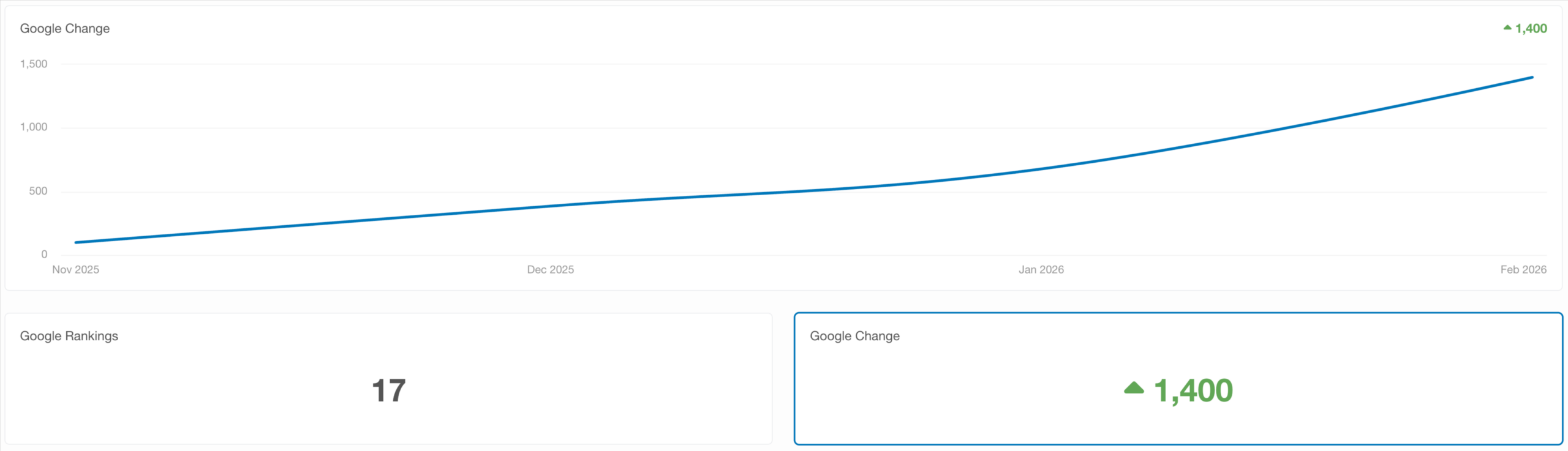
Keyword Rankings: +1,400 Positions Gained Across 56 Tracked Keywords
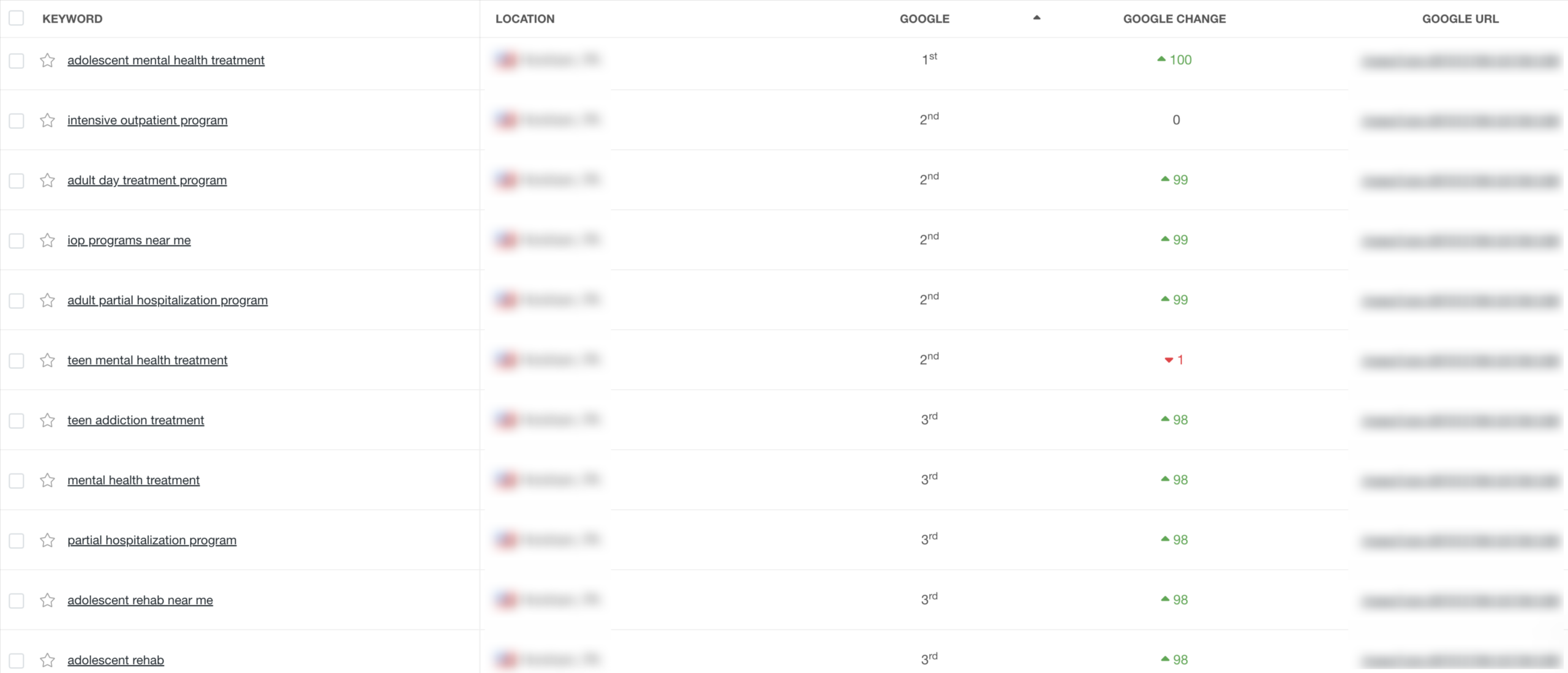
Across 56 keywords tracked in the local market, total ranking positions improved by +1,400. To put that in context: the vast majority of these keywords went from being completely invisible in Google (not found in any position) to ranking on page 1 of Google Maps local pack results. 17 keywords are now actively ranking, up from near-zero visibility at the campaign’s start.
The strongest gains came in keywords directly tied to the facility’s core services:
“Adolescent mental health treatment” reached the #1 position in the local pack, a gain of 100 positions. Keywords like “adult day treatment program,” “iop programs near me,” and “adult partial hospitalization program” all climbed to the #2 position, each gaining 99 positions. “Teen addiction treatment,” “mental health treatment,” “partial hospitalization program,” and multiple variations of “adolescent rehab” all landed in the #3 position, each improving by 98 positions.
Even keywords that haven’t yet reached the top positions are showing strong momentum. “Teen boys treatment program” and “adolescent mental health treatment program” both reached position #11 (gains of 90 each), and “teen drug rehab” moved to position #60 a 41-position improvement that signals early traction in a competitive keyword category.
Organic Search Impressions: 109,000
Over the three-month campaign period, the facility’s website generated 109,000 organic search impressions in Google. The growth trajectory tells the real story: impressions started near zero in November 2025 and climbed steadily each month through February 2026. The increase is a reflection of the campaign ramping up from a standing start; the baseline was effectively zero, which is exactly why the percentage is so dramatic. What matters most is the trend: consistent, compounding month-over-month growth that shows no signs of plateauing.
Organic Search Clicks: 1,502 (Up 8,244%)
Alongside impressions, organic clicks grew to 1,502 during the same period, an 8,244% increase from the near-zero baseline. Again, the percentage reflects the reality of launching a local SEO campaign from scratch. The important signal here is that clicks grew in proportion to impressions, indicating that the content and listings appearing in search results were relevant enough to earn actual engagement, not just visibility.
Google Business Profile Engagement: 336 Website Clicks and 214 Phone Calls
The optimized Google Business Profile became a significant lead generation channel in its own right. GBP-driven website clicks reached 336 (up 48%), and phone call icon clicks from the listing hit 214 (up 50%). These are people who saw the facility in the local pack and took direct action, either visiting the website or calling immediately from the listing. This is the kind of high-intent engagement that translates directly to admissions.
Organic Phone Calls: 108 First-Time Calls (Up 3,500%)
The campaign generated 108 first-time phone calls from organic sources, a 3,500% increase resulting in 4 new admissions. As with the other metrics, this percentage reflects a campaign that started from near-zero call volume. What’s significant is the volume: 108 first-time callers in roughly three months represents a meaningful pipeline of potential admissions flowing directly from organic search visibility. Each call was tracked through dedicated phone numbers assigned to organic channels, so we can confirm these leads came specifically from our local SEO and GBP efforts, not from paid ads, referrals, or other sources.
Organic Form Submissions: 50 (Up 100%)
In addition to phone calls, the website captured 50 form submissions from organic traffic, a 100% increase. Combined with phone calls, this means the campaign generated 158 total organic leads in three months.
Confirmed Admissions and Cost Per Acquisition
In January and February 2026, the campaign produced 4 confirmed organic admissions against a monthly organic spend of $3,000, resulting in a cost per acquisition of $750. For treatment centers where a single admission can generate tens of thousands of dollars in revenue over the course of treatment, this CPA represents a strong return on investment, particularly for a campaign that’s only three months in. As rankings continue to improve and organic traffic compounds, we expect this CPA to decrease further.
Conclusion
In three months, this Pennsylvania-based addiction and mental health treatment center went from near-total invisibility in local search to generating 4 confirmed admissions. This from ranking on page 1 of Google Maps for 17 high-value keywords, generating over 109,000 organic impressions, and producing 158 combined organic leads, including 108 phone calls and 50 form submissions. The campaign has already produced confirmed admissions at a cost per acquisition that delivers clear ROI.
What makes these results particularly noteworthy is what’s still ahead. Of the 56 keywords we’re tracking, a significant number of high-volume terms, including “drug rehab,” “alcohol rehab,” “addiction treatment center,” “rehab center,” and variations targeting PHP, IOP, and outpatient programs are still unranked. These represent the next phase of growth. The foundational work is done: the Google Business Profile is optimized, citation authority is building, and the ranking trajectory is moving sharply upward. As the domain continues to gain authority through ongoing content development, link building, and GBP activity, we expect these competitive terms to start breaking through which will drive even more traffic, calls, and admissions.
This case study reinforces what we see consistently across our behavioral health clients: local SEO is one of the highest-ROI channels available to treatment centers, but it requires specialized knowledge of both the search landscape and the treatment industry to execute effectively. At Lead to Recovery, behavioral health is all we do. That focus is what allows us to deliver results like these in a compressed timeframe while building a foundation for sustained, long-term growth. View more of our marketing case studies to see the results we’ve achieved for other treatment centers.
Ready to Improve Your Treatment Center’s Local Search Visibility?
If your facility is struggling to show up in local search results, or you’re spending money on marketing without being able to track what’s actually driving admissions we should talk. Schedule a 30-minute discovery call to discuss your current strategy and learn how Lead to Recovery can help your center generate more qualified leads through local SEO, Google Business Profile optimization, and conversion rate optimization.