

Written by Matthew Travers, Co-Founder and President, Lead to Recovery. Updated October 18, 2026. Figures come from Lead to Recovery client campaigns tracked in CallTrackingMetrics and from the public sources linked on this page.
Rehab lead generation is the work of producing calls and inquiries from people seeking addiction treatment and turning them into admissions. Lead to Recovery does not sell leads. We build the paid search, SEO, website and call tracking that send calls to your admissions team alone, then manage every channel to cost per admission, which ran $600 and $914 for organic search at two client centers.
Book a Discovery Call
If you prefer to speak with someone
now please call 855-876-7238.
What Is Rehab Lead Generation?
Rehab lead generation covers every channel that puts a person seeking addiction treatment, or a family member, on the phone with a treatment center: paid search, organic search, Google Maps, the center’s website and the forms on it. A lead is a call, a contact form or an insurance verification. Only an admission fills a bed, so we report both and manage to the second.
We do not sell leads
Some companies sell rehab leads by the call or by the inquiry. Lead to Recovery builds the channel instead. The ads advertise your center by name, the calls ring your admissions team and nobody else’s, and the cost per admission falls as the channel matures instead of resetting with every purchase.
It also keeps your marketing inside the rules. Lead generators cannot hold LegitScript certification, which Google, Meta and Microsoft require for addiction treatment ads, and Google does not allow them a Business Profile.

Lead to Recovery client data
Leads Are Not Admissions: The Math From Our Campaigns
A lead count flatters every campaign. The table shows what our clients’ leads turned into, from campaigns tracked call by call in CallTrackingMetrics, with the admissions confirmed by each center’s admissions team.
| Campaign | Channel | Leads | Admissions | Cost |
|---|---|---|---|---|
| Arizona mental health center, Jan to Aug 2026 | Paid search | 808 qualified calls | 32 | $186 per lead |
| Same center, Jan to Aug 2025 | Paid search | 287 qualified calls | 23 | $234 per lead |
| Same center, Jan to Aug 2026 | Organic search | Not reported | 105 | $914 per admission (from $1,548) |
| New Jersey center, first 180 days | Regional SEO | Not reported | 6 to 8 a month by day 180 | $600 per admission |
| Pennsylvania center, Nov 2025 to Feb 2026 | Local SEO and Google Business Profile | 158 (108 first-time calls, 50 forms) | 4 in January and February 2026 | $750 per admission |
| New center, April to October 2024 | Google Ads launch | Not reported | Not reported | $178.50 to $44.89 per lead |
Qualified calls lasted two minutes or longer. Case studies: Arizona, New Jersey, Pennsylvania, new center Google Ads launch.
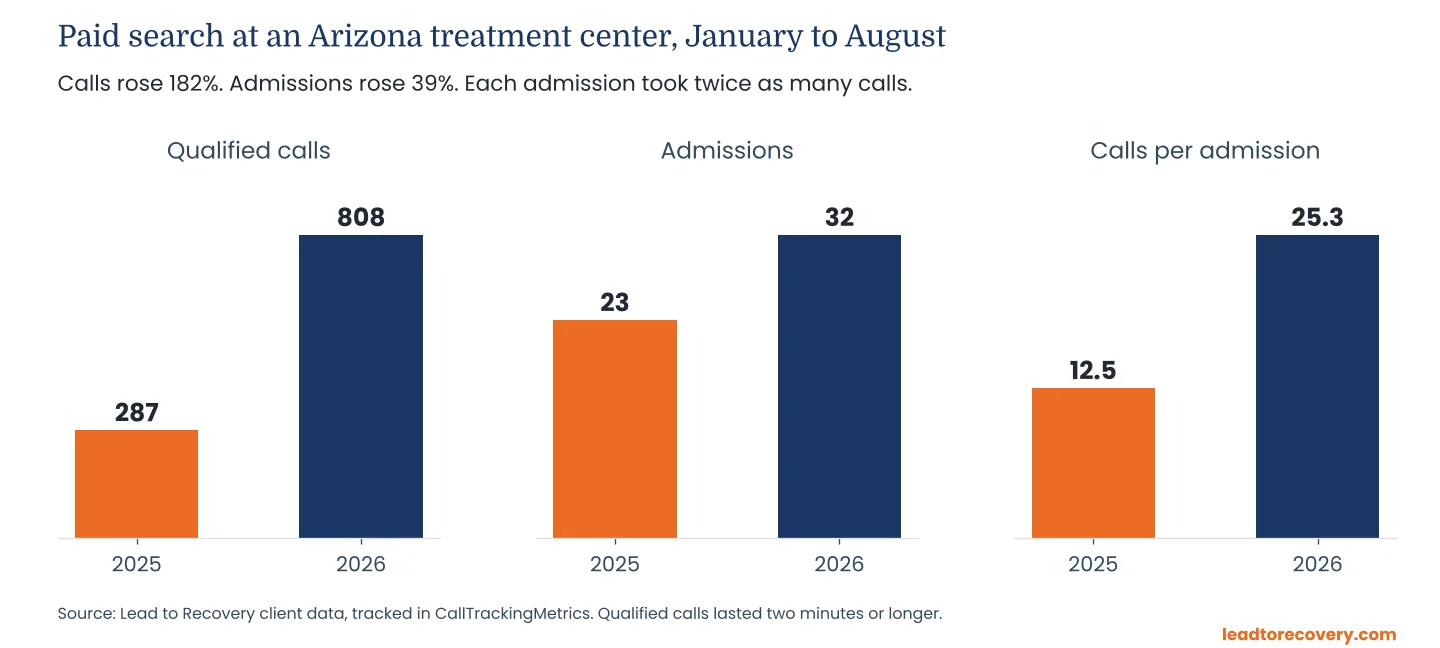
What the Arizona numbers show
Price a purchased lead against the admission
Convert any price per call into a price per admission before you compare it with anything else. The formula:
Maximum price per call = the cost per admission you can accept ÷ calls needed per admission
Worked with the Arizona ratio of 25.3 qualified calls per paid admission (Lead to Recovery calculation):
Your own calls-per-admission ratio is the number that matters. Measure it from your tracking before you buy or build anything.
What an admission is worth
Revenue per admission sets the ceiling on what you can spend to get one. Vermont Medicaid pays $5,185 to $7,030 per high-intensity residential episode. Montana Medicaid pays $264.66 a day, about $7,940 for 30 days. Large employer health plans paid an average of $21,900 per residential treatment stay in 2023, per Peterson-KFF. Against those payments, a $600 to $914 organic cost per admission leaves margin for care. Our study of what rehab costs in 2026 breaks the payments down by level of care.
Bought or built
Buying Rehab Leads vs. Building a Channel You Own
Both put calls on your admissions line. They differ on who else hears from the caller, whether the advertising is allowed, and what happens to the cost the month after you stop paying.
| Question | Bought leads | A channel Lead to Recovery builds |
|---|---|---|
| Who else receives the caller? | Depends on the contract. Ask whether each call is exclusive and get it in writing. | No one. The calls ring your admissions team. |
| Can the ads run on Google, Meta and Microsoft? | Lead generators are not eligible for LegitScript certification, which those platforms require for addiction treatment ads. | Your center holds the certification and the ads run in its name. |
| Does it show on Google Maps? | Google lists lead generation companies as ineligible for a Business Profile. | Your Business Profile ranks in the Maps pack for your programs. |
| Can you trace each admission to its source? | Only what the vendor shares with you. | Every call and form is recorded and attributed in CallTrackingMetrics. |
| What happens to cost over time? | Each lead is a new purchase at the vendor’s price. | Cost falls as the channel matures: a new center’s cost per lead fell 75% in seven months, and the Arizona center’s organic cost per admission fell 41% in a year. |
| How is the fee set? | Per call, per lead or per admission, which puts the contract in EKRA and state patient brokering territory. | A flat monthly fee that does not vary with calls or admissions. Pricing is published. |
The compliance gate
The Rules That Shape Rehab Lead Generation
In addiction treatment, the advertising platforms and federal law both regulate how a lead is produced and paid for. Six rules decide what a lead source can and cannot do.
Lead to Recovery describes what these rules say and builds within them. This is not legal advice; your healthcare counsel confirms how they apply to your center.
Before you sign
8 Questions to Ask Before You Buy Rehab Leads
If a lead vendor is on the table, these questions surface the answers that decide your cost per admission and your compliance exposure.
What we build
What Lead to Recovery Builds Instead of Selling Leads
Six pieces, run as one plan for your center and reviewed with your team every month. Monthly services carry a flat fee and a 90-day minimum, and every price is on our pricing page.
Results measured in admissions
Where Our Clients’ Admissions Come From
Client Testimonials

How an engagement runs
From First Call to Cost per Admission
Questions treatment centers ask
Rehab Lead Generation FAQs

Sources
- LegitScript. Addiction Treatment Certification, accessed October 2026.
- Google Ads Help. Addiction services policy, accessed October 2026.
- Google Business Profile Help. Business eligibility and ownership guidelines, accessed October 2026.
- Legal Information Institute. 18 U.S.C. 220, Illegal remunerations for referrals to recovery homes, clinical treatment facilities, and laboratories, accessed October 2026.
- U.S. Court of Appeals for the Ninth Circuit. United States v. Schena, No. 23-2989, July 11, 2025.
- Florida Legislature. Florida Statutes 817.505, Patient brokering prohibited, 2025.
- Florida Legislature. Florida Statutes 397.55, Prohibition of deceptive marketing practices, 2025.
- Federal Trade Commission. FTC action against R360 under the Opioid Addiction Recovery Fraud Prevention Act, May 17, 2022.
- Peterson-KFF Health System Tracker. Cost and utilization of inpatient mental health and substance use treatment, accessed October 2026.
- Montana Medicaid. Substance use disorder fee schedule, July 1, 2025.
- Vermont Department of Health. Medicaid rate sheet, substance use services, accessed October 2026.
- Lead to Recovery. How Much Does Rehab Cost in 2026? What 100 Treatment Center Websites Disclose, October 2026.
- Lead to Recovery client data: Arizona SEO and PPC, New Jersey regional SEO, Pennsylvania local SEO, new center Google Ads launch.
