

Research and analysis by Matthew Travers, Co-Founder and President, Lead to Recovery. Published October 17, 2026. Data collected October 17, 2026.
A residential rehab stay costs between $5,185 and $21,900 in 2026, and the number depends on who is paying. State Medicaid programs reimburse $5,185 to $7,030 per residential episode in Vermont and about $265 a day in Montana. The one treatment center in our 100-site audit that publishes a price charges $9,000 for 30 nights. Large employer health plans paid an average of $21,900 per residential treatment stay in 2023, with patients owing $1,400 out of pocket on a typical substance use admission. Families searching for the price will not find it on treatment center websites: 99 of the 100 top-ranking centers publish no price for their own care.
Rehab Cost at a Glance
Key numbers
| Figure | What it measures | Source and year |
|---|---|---|
| 99 of 100 | Top-ranking treatment center websites with no published price for their own treatment | Lead to Recovery audit, October 2026 |
| $9,000 | The only published price in the audit: a 30-night residential program in South Dakota | Lead to Recovery audit, October 2026 |
| $15,500 | Average total cost of an inpatient substance use admission, large employer plans | Peterson-KFF, 2023 claims |
| $21,900 | Average cost of a stay at a residential treatment facility, large employer plans | Peterson-KFF, 2023 claims |
| $14,900 | Average cost of a stay at a detoxification facility, large employer plans | Peterson-KFF, 2023 claims |
| $1,400 | Average patient out-of-pocket cost per substance use admission | Peterson-KFF, 2023 claims |
| $264.66 per day | Medicaid rate, clinically managed high-intensity residential (ASAM 3.5), Montana | Montana Medicaid fee schedule, July 2025 |
| $5,185 to $7,030 | Medicaid rate per high-intensity residential episode, Vermont | Vermont DSU rate sheet, December 2025 |
| $6,552 per year | Methadone treatment in a certified opioid treatment program | NIDA, 2021 |
| 74.2% | Share of all US substance use treatment facilities that accept Medicaid | SAMHSA N-SUMHSS, 2022 |
| $1,886 | Average single-coverage deductible, employer plans | KFF Employer Health Benefits Survey, 2025 |
Original research
99 of 100 Treatment Center Websites Do Not Publish a Price
In short: We audited the two treatment centers that rank highest on Google for “drug rehab [state]” in every state, 100 sites in all, and read their admissions, insurance, cost and payment pages. One publishes a price for its own treatment.
Every month about 1,300 people search Google for “how much does rehab cost,” and the cluster of cost searches around it adds up to about 3,000 a month, according to Ahrefs. The pages that answer them belong to directories and lead generators, not to treatment centers. We wanted to know what a family finds when it skips the directory and goes to the center itself.
On October 17, 2026 we pulled the Google results for “drug rehab [state]” in all 50 states and kept the first two single-brand treatment providers in each. Directories, government pages, hospital systems and aggregators were excluded. We then read each site’s homepage and up to six admissions, insurance, cost, payment and financing pages, and coded ten fixed fields. A random 24 of the 100 sites were read a second time in full page text to check the coding. The full method and the dataset are below.
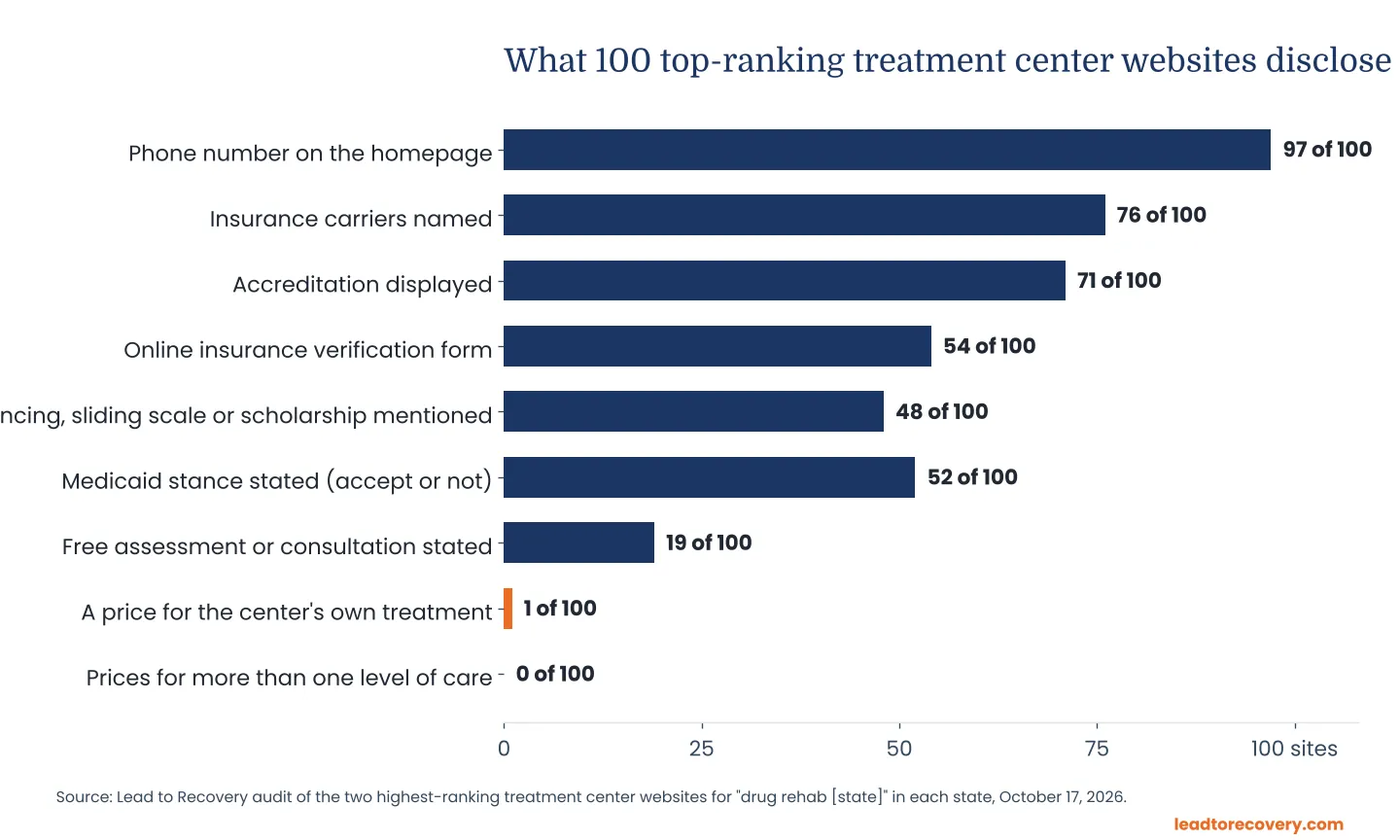
Figure 1. What the 100 audited websites disclose, by field. Source: Lead to Recovery audit, October 17, 2026.
The Medicaid gap between websites and facilities
SAMHSA’s 2022 survey of all 14,854 substance use treatment facilities found that 74.2% accept Medicaid. On the 100 websites in this audit, 30 state that they accept Medicaid, 22 state that they do not, and 48 say nothing either way. The survey counts facilities and the audit counts statements on websites, so the two figures measure different things. The gap still matters to a family on Medicaid: on nearly half of the sites Google ranks first, there is no way to tell whether the center will take them.
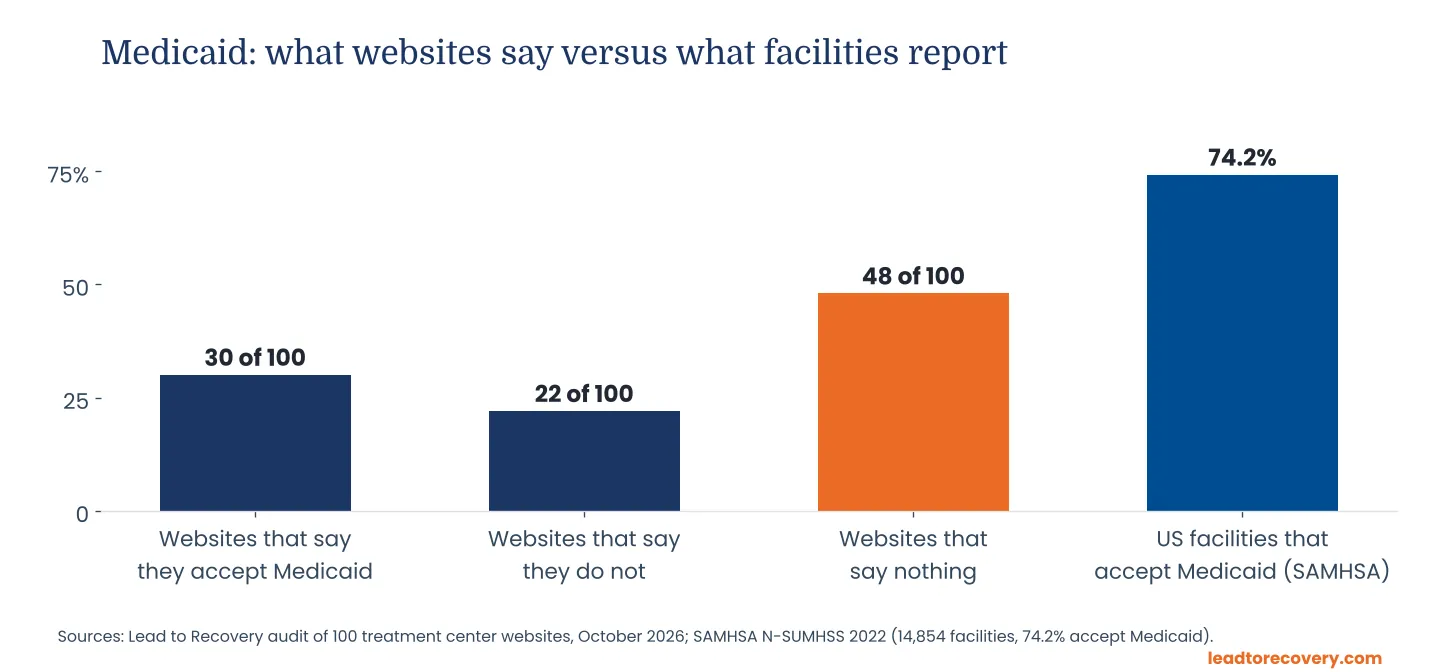
Figure 2. Medicaid statements on the 100 audited websites compared with SAMHSA’s 2022 facility survey.
The same survey found that 58.9% of facilities offer a sliding fee scale and 46.0% offer treatment at no charge or minimal payment for clients who cannot pay. On the audited websites, 48 of 100 mention any form of financing, sliding scale or scholarship.
Public cost data
What Rehab Costs by Level of Care
In short: Treatment centers do not publish prices, but state Medicaid programs and commercial claims data do. Together they give a floor, a midpoint and a ceiling for each level of care.
Three public sources answer the cost question better than any treatment center website. State Medicaid fee schedules publish the rate the state pays for each ASAM level of care, which is the lowest price a licensed program accepts. Commercial claims data from large employer plans show what private insurance pays on average, including the patient’s share. And the one published private-pay price in our audit sits between the two.
| Level of care | Medicaid rate (state, year) | Commercial average, large employer plans (2023) | What it covers |
|---|---|---|---|
| Medical detox (ASAM 3.7) | $307.75 a day, Montana 2025; $200 a day, Oklahoma | $14,900 per detox facility stay; average stay 6 days | 24-hour nursing and physician oversight of withdrawal |
| Residential withdrawal management (ASAM 3.2) | $262.93 a day, Montana 2025; $321.87 a day, Vermont 2025 | Included above | Clinically managed withdrawal with 24-hour support |
| High-intensity residential (ASAM 3.5) | $264.66 a day, Montana 2025; $5,185 to $7,030 per episode, Vermont 2025; $85 to $160 a day, Oklahoma | $21,900 per residential facility stay; stays including residential averaged 19 days | 24-hour structured living with daily clinical programming |
| Low-intensity residential (ASAM 3.1) | $147.79 to $216.43 a day, Montana 2025; $204.68 a day, Vermont 2025; $196.88 a day, Virginia 2022 | Not reported separately | Supervised recovery housing with at least 5 hours of clinical services a week |
| Partial hospitalization (ASAM 2.5) | $456.97 a week, Montana 2025; $500 a day, Virginia 2022 | Not reported | 20 or more hours of programming a week, patient sleeps at home |
| Intensive outpatient (ASAM 2.1) | $398.17 a week, Montana 2025; $250 a day, Virginia 2022; $161.43 per session, Vermont 2025 | Not reported | 9 to 19 hours of programming a week |
| Opioid treatment program (methadone or buprenorphine) | $460.90 a month, Vermont 2024; $150.59 a week, Montana 2025 | $6,552 a year methadone; $5,980 a year buprenorphine (NIDA, DoD estimates) | Medication plus counseling and medical visits |
| Assessment | $212.49 per encounter, Vermont 2025 | Not reported | Clinical evaluation and level-of-care placement |
Medicaid rates are what the state pays a program per day, week or episode. They are the floor of the market, not a price list for private-pay families. Commercial figures are averages of what large employer plans and their members paid in 2023 for an inpatient admission, which bundles the facility, physician and ancillary charges. Virginia rates carry 2022 effective dates and the Oklahoma guide is undated; the others are 2024 to 2025. Sources are numbered at the end of the page.
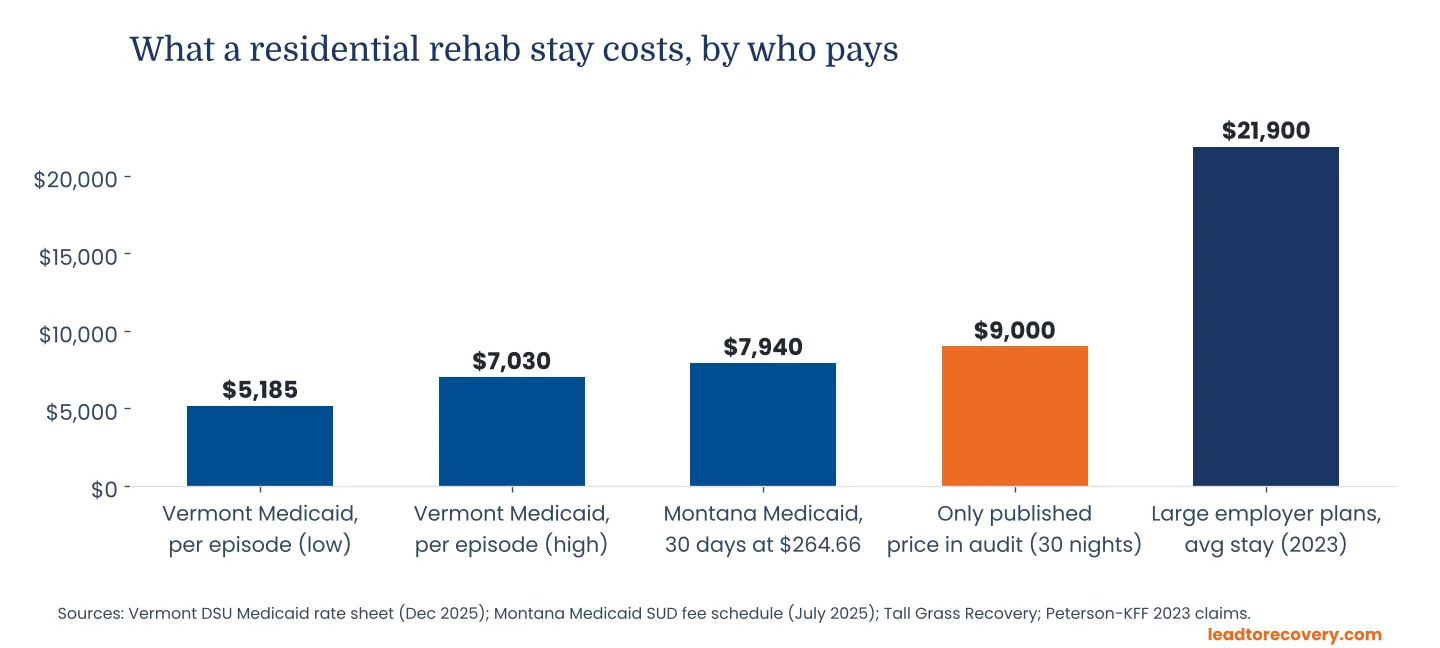
Figure 3. What a residential stay costs by who pays: Medicaid rates, the one published private-pay price, and the commercial average.
How much does inpatient rehab cost?
Inpatient and residential care is the most expensive level. Under Montana Medicaid a 30-day high-intensity residential stay reimburses $7,940 at $264.66 a day. Vermont pays $5,185 to $7,030 for the whole episode, with the rate rising for alcohol and benzodiazepine cases and for co-occurring conditions. The one center in our audit that publishes a price charges $9,000 for 30 nights and does not bill insurance. Large employer plans paid an average of $21,900 for a residential facility stay in 2023, and the average admission with any residential component lasted 19 days.
How much does outpatient rehab cost?
Outpatient costs are published as weekly or per-session rates. Montana Medicaid pays $398.17 a week for intensive outpatient and $456.97 a week for partial hospitalization. Virginia pays $250 a day for IOP and $500 a day for PHP. A standard 8 to 12 week IOP at the Montana rate totals $3,185 to $4,778; at the Virginia daily rate, a 3-day-a-week IOP for 8 weeks totals $6,000. Individual counseling under Vermont Medicaid pays $30.62 per 15 minutes, or $122.48 an hour.
How much does rehab cost with insurance?
With large employer coverage, the average patient paid $1,400 out of pocket for a substance use admission in 2023 and 1 in 4 paid more than $1,900. Those figures follow the plan’s deductible: the average single-coverage deductible in employer plans was $1,886 in 2025. Medicare Part A carries a $1,736 inpatient deductible in 2026. Medicaid patients owe little or nothing, but only where the program accepts Medicaid, which 22 of the 100 audited sites say they do not.
How much does rehab cost without insurance?
Without insurance a family pays the center’s private-pay rate, and 99 of 100 top-ranking centers do not publish it. The public data brackets the answer. The lowest rate a licensed residential program accepts is the state Medicaid rate, $5,185 to $7,940 for a 30-day stay in the states above. The published private-pay price in our audit is $9,000 for 30 nights. Commercial plans paid an average of $21,900 per residential stay. SAMHSA’s survey found 58.9% of facilities offer a sliding fee scale and 46.0% offer no-cost or minimal-payment care for clients who cannot pay, so the uninsured price at many programs is negotiable even where the website says nothing.
How much does medication-assisted treatment cost?
NIDA reports Department of Defense estimates for a certified opioid treatment program: methadone at $126 a week or $6,552 a year with daily visits, buprenorphine at $115 a week or $5,980 a year for a stable patient with twice-weekly visits, and extended-release naltrexone at $1,176.50 a month or $14,112 a year. State Medicaid pays opioid treatment programs a bundled monthly rate, $460.90 in Vermont.
For treatment center operators
The Price Question Is Being Answered by Someone Else
In short: Families ask Google what rehab costs about 3,000 times a month. Directories answer, centers do not, and the center loses the call before it starts.
The two highest-ranking pages for “how much does rehab cost” belong to a directory and a national chain, with 308 and 79 referring domains respectively, according to Ahrefs. Neither is the center a family will admit to. Every cost search they capture is a family that reads a generic range, then calls whichever center the directory lists first.
The audit shows the pattern on the center side. 97 of 100 sites put a phone number on the homepage, 54 have an insurance verification form, and 76 name carriers, so the sites are built to start a conversation. They are not built to answer the first question a family asks. A center that publishes even a starting rate, a per-day Medicaid rate, or a sample bill for a 30-day stay becomes the only ranking site in its state that does.
Lead to Recovery publishes its own prices, and we build cost pages for treatment centers as part of drug rehab SEO and content marketing engagements. A cost page needs three things: the levels of care you offer with a rate or range for each, a plain statement of which payers you accept, and a verification form or phone path for the family that reads it. The conversion work is in the order of those three. If paid search is part of the plan, our LegitScript guide covers what certification requires before the first ad runs.
Methodology
How We Ran the Audit
Sample. On October 17, 2026 we pulled the top 10 Google results (United States) for “drug rehab [state]” in all 50 states from Ahrefs. In each state we kept the first two single-brand treatment providers and excluded directories, aggregators, government and university pages, hospital systems and multi-service agencies. No domain appears twice. North Dakota and South Dakota returned no results for “drug rehab [state],” so “rehab [state]” was used there, and Rhode Island’s second site came from the same substitute query.
Coding. For each site we read the homepage and up to six admissions, insurance, cost, payment and financing pages, and coded ten fields: own treatment price published, prices by level of care, named insurance carriers, Medicaid stance, financing or sliding scale, free assessment, LegitScript, accreditation, phone on the homepage, and online insurance verification form. Intake, deposit and assessment fees do not count as a treatment price. Prices quoted from third-party websites do not count as the center’s own. The rubric was piloted on 10 sites and clarified before the remaining 90 were coded.
Verification. 24 randomly selected sites were read a second time in full page text, including collapsed FAQ sections. The price field matched on all 24. Across the other verified fields, 11 of 120 cells differed and were corrected. Every total was computed twice by separate methods.
Limitations. The sample is the centers families find first on Google, two per state, not a random sample of the 14,854 facilities SAMHSA counts. Coding reads page text, so content loaded by scripts or hidden in collapsed sections can be missed; the price result held at 24 of 24 on re-read, other fields at about 91%. Carrier counts include carriers named in logo alt text and image file names. LegitScript results were the least reliable in verification and are not reported as a headline finding. Public cost benchmarks come from four states’ Medicaid schedules and one national commercial claims study; they describe what payers pay, not what any particular center charges.
Download the dataset
The clean dataset (100 rows, 19 fields, with the state, domain, coded values and notes for each site) is available as a CSV. Cite it as: Lead to Recovery, “How Much Does Rehab Cost in 2026? What 100 Treatment Center Websites Disclose,” October 17, 2026, https://leadtorecovery.com/how-much-does-rehab-cost/. Journalists and researchers may reuse the data with attribution.
Questions families and operators ask
Rehab Cost FAQs
Sources
- Lead to Recovery. “Treatment center website cost disclosure audit: dataset (CSV),” October 17, 2026.
- Peterson-KFF Health System Tracker. “Cost and utilization of inpatient mental health and substance use treatment,” June 29, 2026.
- Montana Department of Public Health and Human Services. “SUD Medicaid Fee Schedule,” effective July 1, 2025.
- Vermont Department of Health, Division of Substance Use Programs. “DSU Medicaid Rate Sheet,” rates effective December 2025 and July 2026.
- Virginia Department of Medical Assistance Services. “Addiction and Recovery Treatment Services (ARTS) Reimbursement Structure,” updated October 4, 2023.
- Oklahoma Department of Mental Health and Substance Abuse Services. “SUD Residential Level of Care (ASAM Level 3) SoonerCare/ODMHSAS Billing Codes,” accessed October 2026.
- National Institute on Drug Abuse. “Medications to Treat Opioid Use Disorder Research Report: How much does opioid treatment cost?,” December 2021.
- SAMHSA. “National Substance Use and Mental Health Services Survey (N-SUMHSS) 2022: United States Substance Use Treatment Profile,” reference date March 31, 2022.
- KFF. “2025 Employer Health Benefits Survey,” October 22, 2025.
- Centers for Medicare and Medicaid Services. “2026 Medicare Parts A and B Premiums and Deductibles,” November 14, 2025.
- Ahrefs. Keyword and SERP data for the terms how much does rehab cost and drug rehab [state], United States, pulled October 17, 2026.
This page reports published payer rates and audit findings. It is not a price quote from any treatment center and not insurance, legal or medical advice. Rates change; check the linked sources for current figures.