Using AI to build a website can feel like the fastest path from idea to launch. An AI website builder can generate layouts, write copy, suggest images, create landing pages, and help you publish a new website in minutes. For healthcare, behavioral health, and treatment center teams, that speed can be tempting.
But your website is not just a digital brochure. It may collect contact details, admissions inquiries, appointment requests, insurance information, or other sensitive data that needs to be protected. An AI-generated website may look polished, but the real question is whether it can stay secure, compliant, editable, scalable, and reliable over time.
If your website was built quickly and you are unsure whether the foundation is secure, call Lead to Recovery at 855-876-7238. We can help you review the structure, performance, and conversion path before small issues become expensive problems.
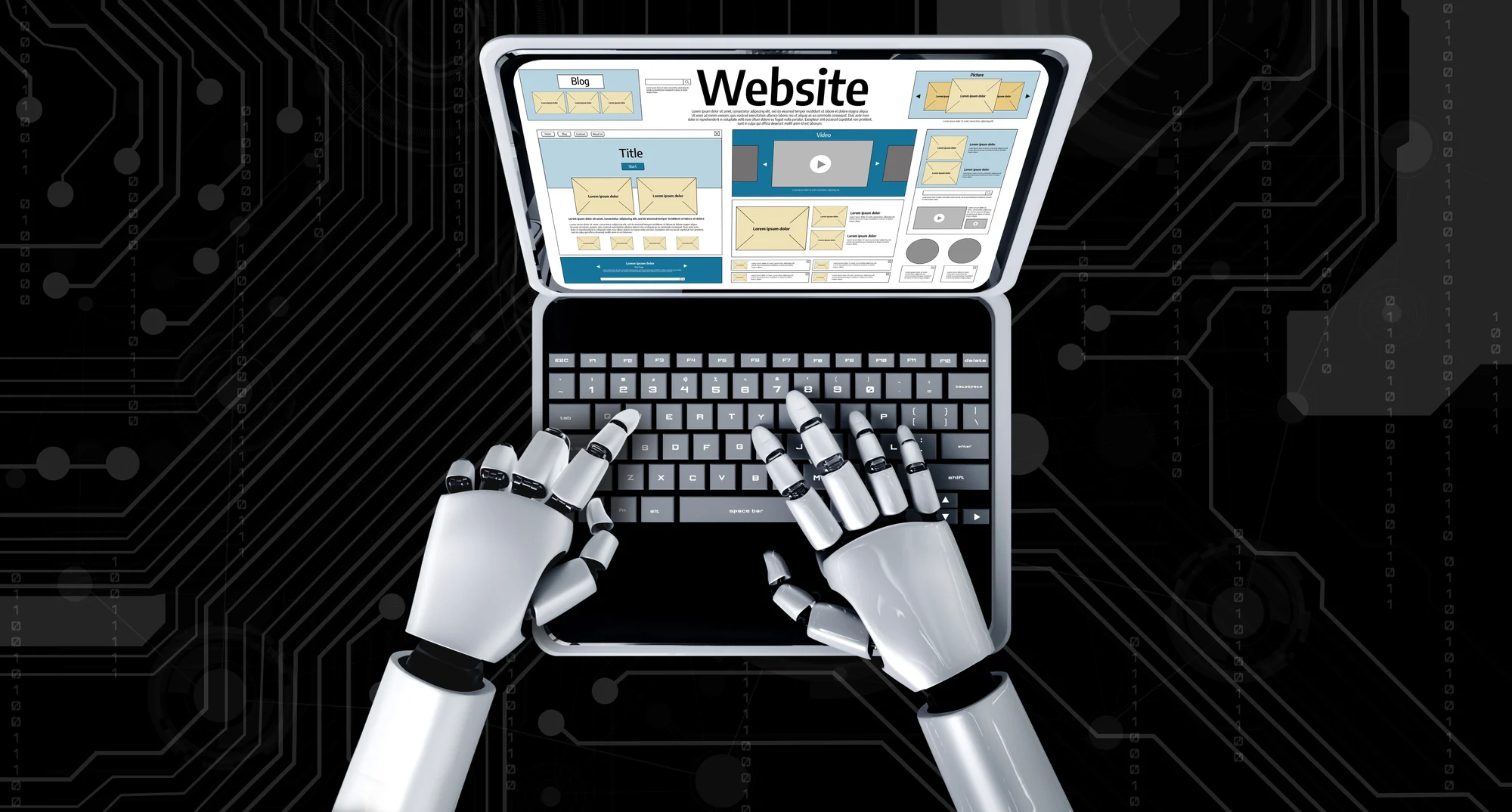
Using AI to Build a Website Can Create More Than Design Problems
AI website builders are popular because they remove friction. You can describe what you want in plain language, choose a design direction, adjust a few sections, connect a custom domain, and launch a complete website without coding experience.
For a simple personal site, that may be enough. For your healthcare or behavioral health organization, the stakes are higher. Your website needs to support trust, protect user data, guide people to the right next step, perform well in search engines, and connect cleanly with your intake and marketing systems.
That is where AI-generated sites often fall short. Many AI powered website builders focus on speed and convenience. What they do not always provide is production-ready code, secure form architecture, HIPAA-aware workflows, clean WordPress compatibility, or long-term technical ownership.
The Hidden Costs of Using AI to Build a Website
The hidden costs of an AI generated website usually appear after launch. At first, your site may look modern, mobile friendly, and easy to use. Then your team starts editing pages, adding plugins, improving SEO, installing tracking, or changing forms.
That is when the problems surface.
Common long-term risks include:
- Technical debt that slows the site down
- Platform conflicts that make updates difficult
- Security risks tied to forms and user input
- Maintenance costs that erase the upfront savings
- Limited scalability as your organization grows
A free AI website builder or basic plan may seem cost-effective in the beginning. But if your site later needs a rebuild, security cleanup, SEO repair, or custom development, the real cost can become much higher than expected.
Code Quality and AI-Generated Technical Debt
AI tools can generate functional snippets quickly, but functional does not always mean clean, efficient, or maintainable.
A skilled developer considers your design system, page templates, integrations, performance goals, tracking needs, and future updates. An AI builder reacts to prompts. It may create something that works in the moment without understanding how that code will affect your entire website later.
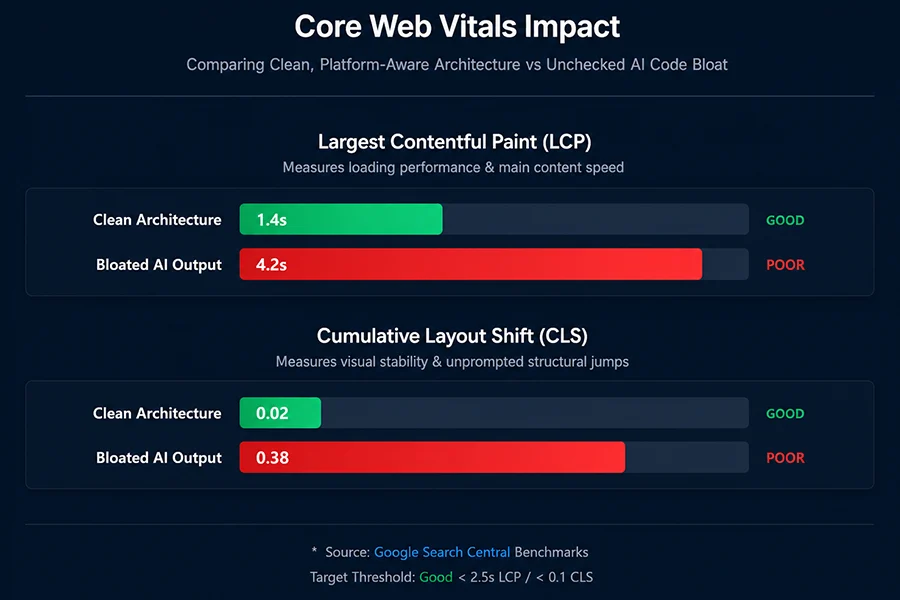
Bloated Code Can Slow Performance and Hurt Core Web Vitals
AI generated code often uses more code than necessary. It may load full libraries for small effects, duplicate functions, add excessive wrappers, or create messy CSS that becomes harder to manage over time.
That can lead to slower load times, poor Core Web Vitals, higher hosting resource usage, weaker SEO performance, and more difficult technical audits.
For your treatment center website, speed is not just a technical concern. A slow website can reduce trust and increase the chance that a high-intent visitor leaves before calling, submitting a form, or reading about your services. Google Search Central’s Core Web Vitals guidance explains that these metrics measure real-world user experience for loading performance, interactivity, and visual stability.
AI-Generated Snippets Often Lack Architectural Planning
AI can create a section, form, animation, or landing page. What it often lacks is a clear architectural strategy.
That can create inconsistent naming, repeated code, mixed design patterns, poor separation between content and functionality, and pages that are difficult to scale or hand off.
This becomes especially risky when your site needs location pages, program pages, service hubs, blog templates, campaign landing pages, or intake-related workflows.
Cookie-Cutter Layouts Can Weaken Trust
Many website builders and AI website generators rely on similar template structures. Even when the colors, images, and copy are different, the final site can still feel generic.
That matters in behavioral health. Your visitors may be comparing treatment options during an emotional, high-stakes moment. If your site looks like every other AI built website, it may not communicate the trust, clinical seriousness, or brand differentiation your organization needs.
Source: Google Search Central Benchmarks
WordPress System Friction: Page Builder and Plugin Conflicts
WordPress works best when themes, plugins, custom code, and page builders follow the correct structure. AI generated code often does not respect that structure.
Popular builders such as Avada, Elementor, Divi, WPBakery, and Beaver Builder rely on specific rendering systems, hooks, theme functions, and responsive controls. AI generated snippets may bypass those systems and inject raw HTML, CSS, or JavaScript directly into a page.
The section may look fine at first. Then your team tries to edit it inside the builder and realizes it cannot be managed like the rest of the site. WordPress plugin hooks show why clean integration matters when custom functionality needs to work inside the WordPress ecosystem.
Plugin Conflicts Can Break Critical Features
WordPress plugins rely on action hooks, filters, database conventions, APIs, and security validation layers. AI generated code may skip nonce validation, bypass plugin APIs, create direct database queries, or conflict with SEO tools, form plugins, call tracking, analytics scripts, or membership systems.
This creates a fragile setup. A plugin update, PHP update, theme update, or WordPress core update can cause a working feature to fail.
For your healthcare website, that can interrupt contact forms, admissions workflows, appointment requests, or insurance verification paths. If your WordPress site needs to stay editable while supporting SEO, analytics, and intake functionality, Lead to Recovery’s rehab website enhancement services can help strengthen the foundation without forcing a full rebuild.
How AI Refactoring Can Break Intake Workflows
One of the biggest issues with AI assistance is lost context.
You may ask an AI tool to adjust one section, but it changes another piece of code in the process. It may rename variables, remove a dependency, rewrite structural markup, change CSS specificity, or delete something that another part of the page still needs.
Suddenly, forms stop submitting, layouts break on mobile, tracking scripts fail, JavaScript errors appear, insurance forms behave unpredictably, or a previously working section collapses.
For patient-facing websites, this is not a minor inconvenience. If a form fails silently, your team may lose leads without realizing it. If tracking breaks, you may misread campaign performance. If sensitive data is handled poorly, the risk becomes more serious.
Your website needs structured QA before launch, not casual testing after something breaks.
Hidden Time Costs: Prompting vs. Professional Engineering
AI website builders often promise speed, but AI is rarely one-and-done.
You may spend time writing prompts, clarifying instructions, regenerating layouts, debugging code, fixing responsive issues, replacing generic copy, checking SEO settings, testing forms, and asking another AI tool to repair what the first one created.
At that point, the free plan, free domain, or low monthly cost no longer reflects the true investment.
AI can help speed up parts of web design. It can generate content, assist with wireframes, and support simple prompts. But it should not replace professional judgment when your website supports marketing performance, sensitive inquiries, or healthcare intake pathways. For treatment centers and behavioral health brands, professional addiction treatment website design should connect design, SEO, conversion strategy, and patient trust from the start.
Cybersecurity Guardrails: Vulnerabilities, Data Leaks, and Compliance Exposure
Security is one of the most important concerns when using AI to build a website.
AI models are trained on large public datasets, and those datasets may include insecure code patterns. As a result, AI generated code can reproduce common vulnerabilities unless an experienced developer reviews and hardens the output.
Common issues include missing input sanitization, output escaping, nonce verification, access controls, input validation, and secure error handling.
These gaps can expose your website to SQL injection, cross-site scripting, CSRF attacks, broken access control, and insecure design patterns. The OWASP Top 10 web application security risks are a strong reference point for understanding the vulnerabilities that can affect modern websites.
AI may also generate examples with hardcoded API keys, access tokens, passwords, or insecure configuration patterns. If those details are copied into a live site or pushed to a public repository, sensitive data can be exposed.
For healthcare and behavioral health websites, these risks are not abstract. Your site may collect patient inquiries or PHI-adjacent information, which requires stronger safeguards than a basic brochure site.
HIPAA-Compliant Web Design Requires More Than a Working Website
A website can look professional and still fail basic privacy expectations.
HIPAA-compliant web design is not just about having a form that works. You need to understand how data is collected, transmitted, stored, accessed, and protected. You also need to evaluate whether analytics tools, form plugins, chat widgets, booking systems, and CRM integrations are appropriate for healthcare use.
Before you rely on an AI website creator or AI powered website builder, ask:
- Does the platform support secure form handling?
- Where is submitted data stored?
- Who can access the data?
- Are third-party scripts collecting sensitive information?
- Are forms protected with validation and encryption?
- Is there a business associate agreement where needed?
- Can you control hosting, backups, permissions, and user access?
The NIST Secure Software Development Framework provides standards-based guidance for reducing vulnerabilities in software, while the HHS HIPAA Security Rule outlines safeguards for protecting electronic protected health information.
Compliance review should happen before launch, not after a breach, complaint, or failed intake workflow.
Maintenance, QA, and Platform Lock-In
AI generated code often shifts work from the beginning of the project to the maintenance phase.
Your developers may need to inspect code quality, test forms, validate plugins, review tracking scripts, fix CSS conflicts, improve accessibility, clean up SEO structure, and document how the site actually works.
A website is not static. WordPress core updates. PHP versions change. Plugins release patches. Servers evolve. Browsers update. Security standards shift. When your site depends on fragile AI generated code, every update can create a new risk.
Many AI website builders also create platform lock-in. Some do not export clean code. Others use proprietary frameworks or limit backend control. If you outgrow the platform, you may need to rebuild the site from scratch instead of migrating cleanly.
Why Automated Builds Lack Medical Integration Depth
AI can customize the surface layer of a website. It can change colors, write copy, generate sections, and create landing pages.
But deeper healthcare website development may require custom treatment program templates, location page architecture, provider pages, CRM integrations, call tracking, analytics, secure form routing, insurance verification workflows, HIPAA-aware intake processes, SEO content hubs, and conversion-focused landing pages.
Those systems require deliberate architecture. AI assistance can support execution, but it should not own the strategy.
AI Website Builders vs. Professional Healthcare Website Development
| Feature | AI-Driven Development | Professional Healthcare Website Development |
|---|---|---|
| Initial speed | Fast | Moderate |
| Code quality | Often inconsistent | Planned and reviewed |
| WordPress Compatibility | Can conflict with builders and plugins | Built around platform standards |
| Security | Requires expert review | Designed with guardrails |
| Scalability | Limited by structure | Built for growth |
| Compliance readiness | Not guaranteed | Planned into the workflow |
| Long-term cost | Can rise through fixes and rebuilds | More predictable with maintenance |
| Customization depth | Surface-level | Structural and strategic |
| Ownership | May include platform lock-in | Greater control and portability |
AI tools may be appropriate for early ideation, simple mockups, quick internal prototypes, or low-risk sites that do not collect sensitive data.
Professional development is safer when your site supports patient inquiries, admissions, healthcare marketing, paid campaigns, SEO growth, CRM integrations, or compliance-sensitive workflows. Lead to Recovery’s drug rehab SEO services and rehab conversion rate optimization services are designed to help treatment websites turn visibility into qualified calls and admissions.
A Safer Alternative: Structured WordPress Builds With Secure Enhancements
The better alternative is not always a fully custom website from scratch.
A structured WordPress build using a tested framework or premium theme can control cost while reducing risk. A professionally configured layout, such as one built on a reliable system like Avada, can provide a stronger foundation than a random AI generated site.
This approach gives you tested responsive behavior, better plugin compatibility, cleaner editing workflows, more predictable maintenance, stronger SEO structure, room for custom development, and lower risk than unvetted AI generated code.
From there, your team can customize branding, typography, imagery, messaging, page structure, CTAs, and conversion paths without breaking the underlying architecture.
If your website was built with AI, or if you are considering an AI website builder, call Lead to Recovery today at 855-876-7238. Our team can help you evaluate the security risks, harden your digital foundation, and build a safer, compliance-ready path forward.
Frequently Asked Questions
Sources
Google Search Central. (n.d.). Understanding Core Web Vitals and Google Search results. Google for Developers.
National Institute of Standards and Technology. (n.d.). Secure Software Development Framework. NIST Computer Security Resource Center.
Office for Civil Rights. (n.d.). The HIPAA Security Rule. U.S. Department of Health and Human Services.
Open Web Application Security Project. (n.d.). OWASP Top 10. OWASP Foundation.
WordPress Developer Resources. (n.d.). Hooks. WordPress Developer Resources.